
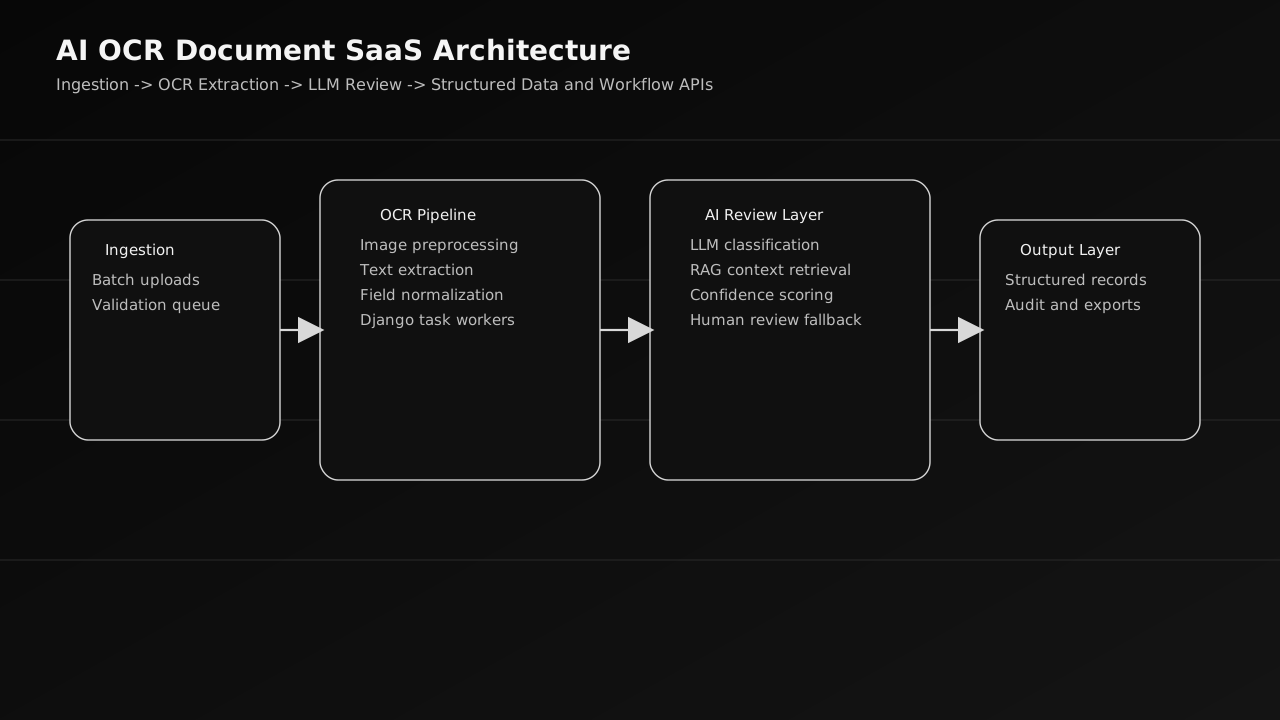
This product addressed high-volume document operations where manual extraction and classification created bottlenecks. The system architecture combined OCR pipelines with AI-assisted review to improve speed while keeping human controls for low-confidence cases.
Problem
Document-heavy workflows suffered from slow turnaround and inconsistent extraction quality when handled manually.
Constraints
- Throughput had to scale across variable document formats and quality levels.
- Extracted fields required confidence-aware validation before downstream system write.
- Operators needed clear escalation paths for low-confidence or ambiguous cases.
Architecture
- Django orchestration layer for ingestion control, workflow state, and API access.
- OCR stage to normalize unstructured scans into machine-processable text.
- LLM-assisted review and RAG context retrieval to improve classification quality.
- PostgreSQL-backed trace and audit records for reproducibility.
Tradeoffs and Failures
- Aggressive automation improved speed but occasionally reduced precision on noisy documents.
- High-confidence thresholds protected data quality but increased manual review load.
- Retrieval-enhanced review improved context accuracy while adding pipeline complexity.
Engineering Impact
- Automated large portions of document intake and classification.
- Reduced repetitive manual operations through layered extraction and AI review.
- Improved downstream integration through structured outputs and auditable states.
Outcomes
- Higher processing throughput with clearer confidence signals.
- Better consistency in document categorization rules.
- Stronger integration readiness for enterprise back-office systems.
What Made This Approach Different
The implementation treated OCR and AI as cooperative layers with explicit confidence boundaries, not as a single black-box classifier.